
China’s First Rover on Mars
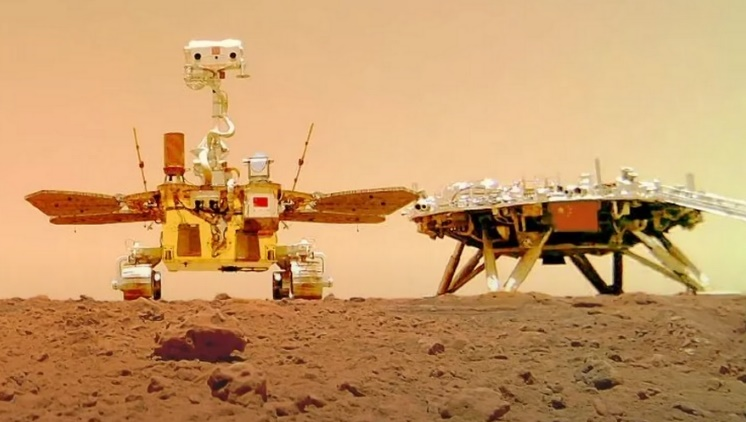
One of the long-term hopes of all space exploration countries is to confirm the existence of life on Mars and to determine how suitable it is for human habitation. Some countries have successfully landed their rovers on Mars. China is one of them who achieved its long-term goal.
“Zhurong” is a Mars rover that is China’s first rover to land on another planet which was named after a Chinese god of fire. With this successfully landing China has become the third country to land a spacecraft on a red planet after the US and Russia. Zhurong is part of the Tianwen-1 mission to Mars conducted by the China National Space Administration.
The spacecraft launched on 23 July 2020 from the Wenchang lunch site and inserted into Martian orbit on 10 February 2021. The lander which carried the rover, successfully landed on 14 May 2021 in Utopia Planitia and Zhurong was successfully deployed on 22 May 2021. The lander first utilized a heat enter to the Martian atmosphere, then a huge parachute to descent towards the surface, before eventually landing successfully using a “retro engine”. Tianwen-1 which is still in orbit will now serve as a relay between Zhurong and the Earth.
The Zhurong rover carries six scientific instruments. One of the most exciting instruments in the rover is the “Mars Rover Penetrating Radar (RoPeR)” which is also known as Ground-penetrating Radar. This is used to search for pockets of water or ice below the surface. This is pining the surface with two different frequencies and picking up echo data from the layer below. “Mars Rover Magnetometer (RoMAG)” measures the fine-scale structures of crystal magnetic field based on the mobile measurement on the Martian Surface. “Mars Climate Station (MCS)” measures the temperature, pressure, wind velocity, and direction of the surface atmosphere and this has a microphone to capture Martian sounds. The next one is “Mars Surface Compound Detector (MarSCoDe)” and it combines laser-induced breakdown spectroscopy and infrared spectroscopy.
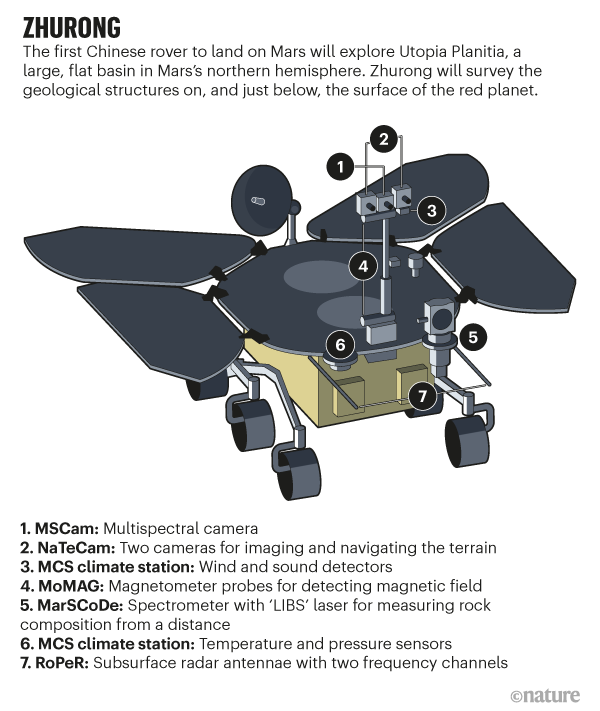
“Multispectral Camera (MSCam)” combined with MarSCoDe investigates the mineral components to establish the relationship between Martian surface water environment and secondary mineral types, and to search for historical environmental conditions for the presence of liquid water. The last one is “Navigation and Topography Cameras (NaTeCam)”. NaTeCam is used to construct topography maps, extract parameters such as slope, undulation, and roughness, investigate geological structures, and conduct a comprehensive analysis on the geological structure of the surface parameters with 2048 x 2048 resolution.
The rover had a planned operational lifetime of 90 sols (Days on Mars). Every three sols were defined as one operation period. The basic process of each operation period was:
- Sol 1: NaTeCam captures images on Martian surface for analysis and operations planning
- Sol 2: Each payload performs scientific exploration.
- Sol 3: The rover moves towards the target location. RoMAG and MCS collect data when roving.
Based on two criteria the landing area was determined. Those two criteria are,
- Engineering feasibility
- Scientific Objectives.
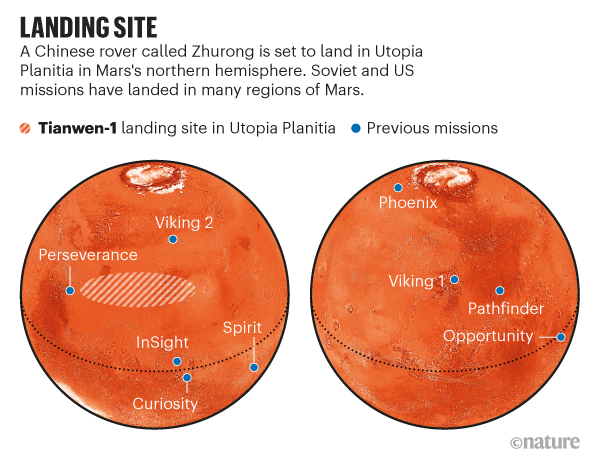
According to the above two criteria, two areas were selected which were Chryse Planitia and Utopia Planitia. Utopia Planitia was more favored due to the higher chance of finding proof about whether an ancient ocean ever existed on the north part of Mars. So, it was selected as the landing area.
The rover’s mission planned tasks are to study the topography and geology of the local area, examine the soil, and any ice content, survey the elements, minerals, and rocks, atmospheric sampling.
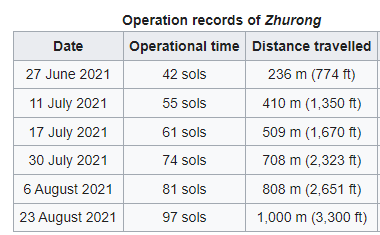
As of 11 July 2021, CNSA announced that Zhurong had traveled more than 410m on the Martian surface. Zhurong paid a visit to the parachute and backshell that were dropped onto the Martian surface following its landing on May 14, 2021. Zhurong had completed its planned exploration tasks as of August 15, 2021, and will now keep driving towards the southern part of Utopia Planitia, where it landed. Even though the rover’s lifespan has ended, it may still roam the Martian surface and transfer data to the Tianwen-1 Mars orbiter until its functions are no longer usable.
Author : Esana Kandanaarachchi
8th Batch
Rover & Robotic division